01
Curated foundation
Developed on high-quality curated imaging drawn from more than 2,100 hospitals — breadth of scanner, protocol and population, not a single-site cohort.
The platform
Layer one · Cleared
FDA 510(k) cleared for triage and notification of suspected peripheral arterial occlusion. Above 90% patient-level sensitivity reported in validation.
01
Developed on high-quality curated imaging drawn from more than 2,100 hospitals — breadth of scanner, protocol and population, not a single-site cohort.
02
Cloud or on-premises, with integration designed to be frictionless against existing PACS and reporting infrastructure.
03
The architecture follows how a vascular read is actually performed — territory by territory — rather than producing a whole-study classification.
04
Consistent, structured reporting that reduces interpretive variability between readers and between studies.
Structured output · schematic
Outcomes. Earlier identification creates a preventive window — the difference between managing disease and responding to an event, including limb loss.
Consistency. The same study read twice produces the same structure, which is what makes comparison over time meaningful.
Efficiency. A force multiplier on high-volume worklists, prioritising the studies that warrant attention rather than adding a queue.
Coordination. Earlier detection gives the downstream service line time to act, instead of inheriting a patient who has already progressed.
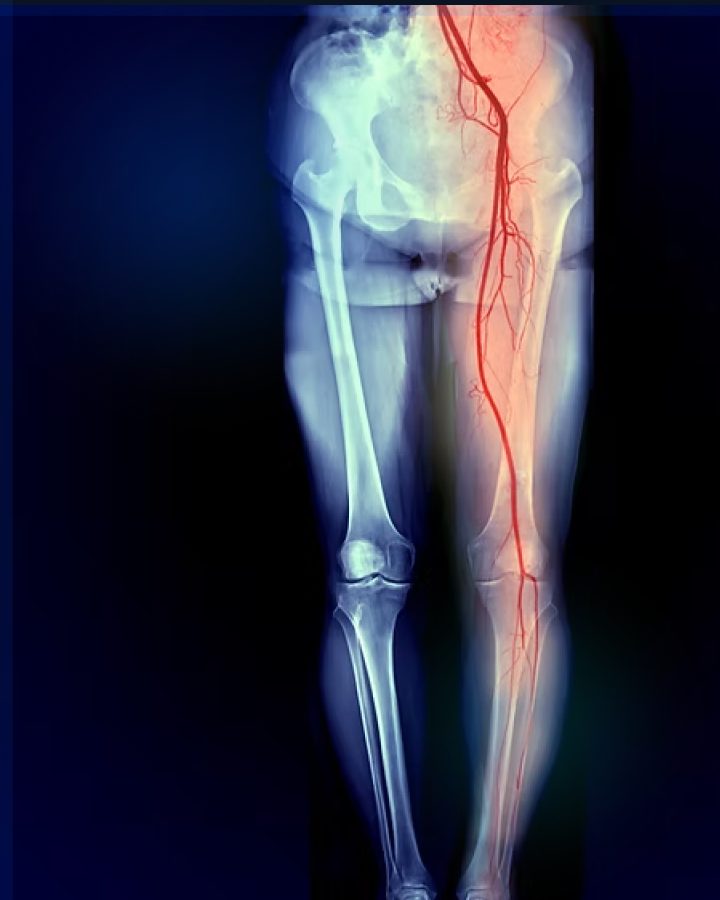
What it reads
Cross-sectional imaging taken for something else routinely covers the aorto-iliac and infra-inguinal vessels. VascularAssist™ reads that coverage for occlusive disease rather than asking for a new acquisition.
Illustrative angiographic rendering, not output of the cleared device.
The viewer
Illustrative screen capture of the GuideAI Health viewer. Segment-level stenosis quantification and plaque characterisation shown here are investigational, are not cleared by the FDA, and are outside the VascularAssist™ Occlusion Triage clearance for triage and notification.
Layer two · In development
A clinical workflow platform that converts imaging findings into coordinated, longitudinal patient care.
The gap Elevate addresses
— Imaging findings stay siloed across departments.
— Follow-up is inconsistent, or missed outright.
— Coordination breaks between radiology, primary care and specialty services.
AI has improved detection considerably. It has not, on its own, improved what happens after the detection — and that is where the outcome is actually determined.
Disease programmes in scope
| Peripheral arterial disease | The founding indication. Detection, characterisation and longitudinal follow-up. |
| Carotid disease | Second module in development; CarotidAssist clearance targeted for Q1 2027. |
| Coronary artery disease | In programme design, on the same capture–standardise–route–track structure. |
Status. Elevate is in development and is currently being designed with health system partners for clinical pilots. It is not cleared by the FDA. Only VascularAssist™ Occlusion Triage, for the triage and notification indication, holds 510(k) clearance.
Regulatory status
| Module | Intended use | Status |
|---|---|---|
| VascularAssist™ Occlusion Triage | Triage and notification of suspected peripheral arterial occlusion. Adjunct to the standard of care; not for primary diagnostic interpretation. | FDA 510(k) cleared — June 2026 |
| Quantified stenosis & plaque burden | Segment-level quantification and plaque characterisation. | Investigational — not cleared |
| CarotidAssist | Carotid disease detection. | In development — clearance targeted Q1 2027 |
| Elevate | Clinical workflow, routing and longitudinal tracking. | In development — not cleared |
Cleared, not approved. GuideAI Health’s device was reviewed under the FDA 510(k) pathway, which is granted on the basis of substantial equivalence to a legally marketed predicate device. It is not a PMA approval and it is not a finding of clinical superiority. We describe it as cleared, for a named indication, and make no claim beyond that indication.
Integration & assurance
| Deployment | Cloud or on-premises, to suit the institution’s data posture |
| Workflow | Into existing PACS and reporting infrastructure — no parallel viewer |
| Data handling | HIPAA documentation and Business Associate Agreement available |
| Diligence pack | Security questionnaire responses, model and data governance documentation on request |
A time-boxed evaluation with agreed success metrics, run on your imaging, before anyone signs anything.